Enquiry List () (0)


- 15 Jan 2026
Saline Eyewash vs. Eye/Face Washes: Which One Do You Need?
Choosing the appropriate emergency equipment for workers handling harmful chemicals can be a difficult task. Understanding the difference between a saline eyewash bottle and an eye/face wash station, for example, is paramount when it comes to providing the right protection. In a chemical emergency, it can be the difference between temporary discomfort and severe eye damage. Many industrial sites rely on saline bottles or pods for protection against harsh chemicals, without realising that most of these products are designed for minor irritants rather than chemical accidents.
For site managers and purchasers, understanding the limitations of saline bottles – and where they are or are not appropriate – is essential to specifying effective decontamination provisions that genuinely protect workers in the event of an accidental chemical splash or spillage.
 What is a Saline Eyewash Used For?
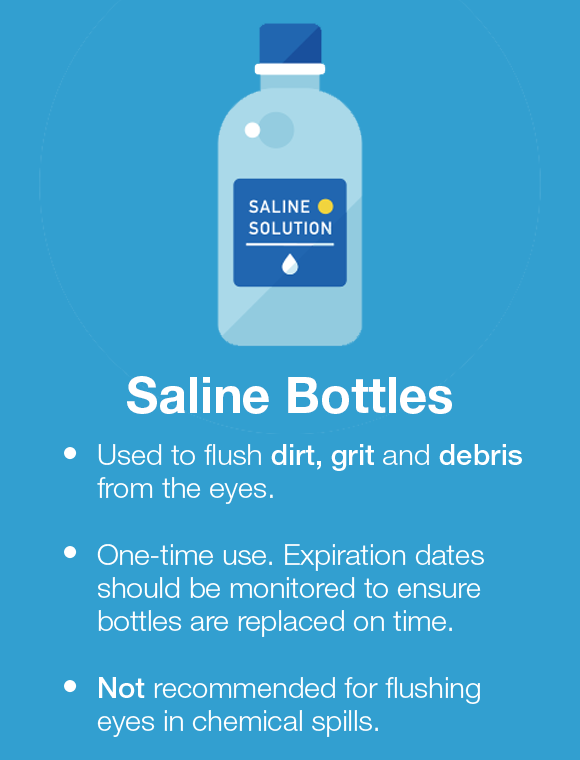
Saline eyewash bottles certainly have their place: they are useful for one-time rinsing of debris, such as dust or grit, and as a supplementary measure for the casualty to keep rinsing their eyes during transport to medical care. It should be noted that these bottles have an expiry date and should be replaced, on average, every 2 years, even if they remain unopened.
Saline Eyewashes in Chemical Spills
For chemical accidents, safety standards stipulate that an eyewash must be simple to activate, activate within 1 second, and provide 15 minutes of continuous water flow. The unit must be able to flush the eyes for the full 15 minutes after being activated without the use of the user’s hands and must flush both eyes simultaneously. Plumbed-in systems are required to provide 12 litres of aerated water per minute to achieve compliance, though self-contained units have a much lower requirement of 1.5 litres per minute.
Unfortunately, this is where many eyewash bottles aren’t compliant. Some saline bottle solutions feature screw-on bottle caps, which, in an emergency, can be cumbersome for a casualty to operate. This isn’t necessarily a large problem if the casualty has a minor, non-toxic irritant in their eyes, but if the contaminant is a potent chemical, this added time can cause further unnecessary damage. Furthermore, many of these bottles are only capable of flushing one eye. To flush both eyes simultaneously, the casualty would need a second bottle, requiring even more setup time.
Many sodium chloride bottles require the user to continuously squeeze the bottle for the solution to come out, causing inconsistent and insufficient water flow. Saline pods and many saline bottles do not contain enough liquid to provide a full 15-minute decontamination or even enough to reach the necessary flow rate to treat a chemical injury. There are exceptions to these trends, with some brands designing eyewash bottles that provide 15 minutes of decontamination but at a low flow rate. However, there are significant differences between brands, and the safety datasheet must always be consulted to check the specific use for each.
Saline bottles are best kept on hand and reserved for flushing low-risk debris only. For chemical splashes, eye/face wash stations are the only option to ensure a thorough decontamination, mitigation of harm, and compliance to safety standards. Hughes manufactures a wide range of eye/face wash stations for all industrial settings, ensuring there is no site incapable of properly protecting workers.
 Eye/Face Washes for Chemical Spills
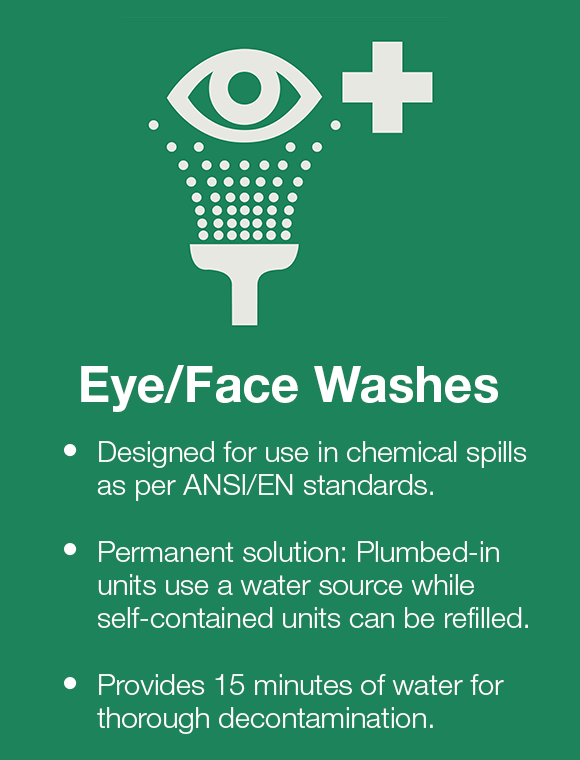
Where a reliable water source is available, plumbed-in eye/face washes are recommended. Units, such as the STD-45G, provide over 15 minutes of continuous water flow at 12 litres per minute, compliant with international safety standards. The unit has an integral lid connecting to the water valve for automatic operation when the lid is pulled down, providing quick and seamless activation. This design also protects the diffusers and bowl from external debris and contaminants.
For sites without a reliable water source, Hughes have a range of self-contained eye wash stations. These include either gravity-fed units, usually for table or wall-mounting, or pressurised models for portability and positioning closer to the hazard.
The Optiwash is a gravity-fed unit which can be mounted to a nearby wall using the included bracket. The eye wash activates using the pull-down manifold and will remain operational, without the use of the casualty’s hands, for the full decontamination period. Optional heated or insulated jackets are available for units installed outdoors.
Portable options include the STD-58G, a pressurised unit with simple push-plate activation. Once activated, the protective dust covers release automatically, allowing the casualty to hold their eyes open over the flow of water for 15 continuous minutes.
All staff, contractors, and site visitors should receive proper training during their site induction that differentiates between decontamination and first aid equipment. This training should also outline the correct method of operation for each unit to ensure that they are sufficiently informed on how to use the correct equipment in an accident or emergency.
Contact the Experts at Hughes
For further information, Hughes’ expert team are on hand. Ensure your workers have the appropriate protection – contact Hughes today using the contact form.